
Bread and Circuses: The Oldest Warning About Modern Power
How a 2,000‑Year‑Old Roman Insight Explains the Modern Drift Toward Spectacle Governance

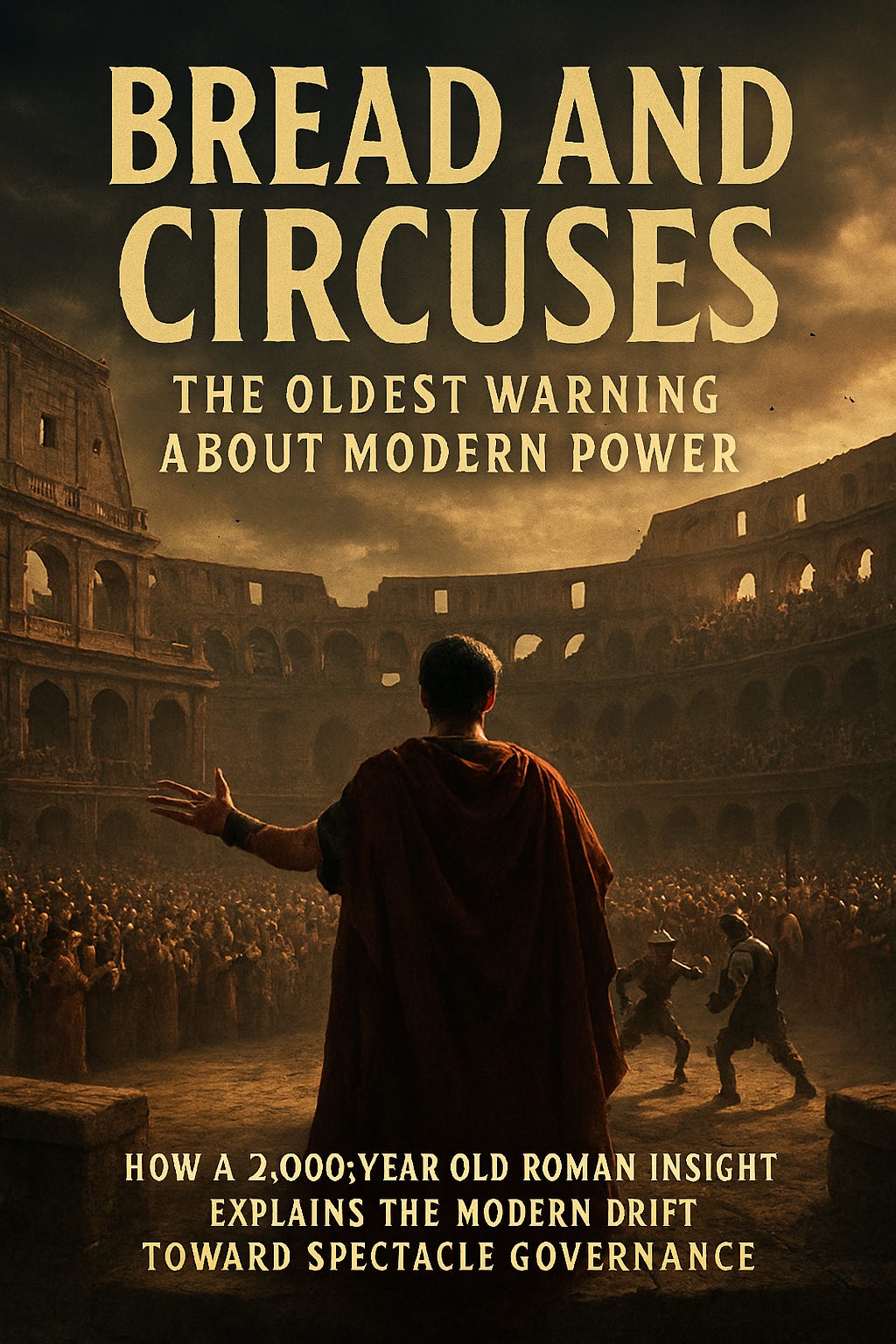
The Roman poet Juvenal never imagined cable news, social media feeds, or a White House press event designed like a pay‑per‑view fight card. Yet his warning—panem et circenses, “bread and circuses”—reads today like a diagnosis of a political culture that has traded civic agency for emotional stimulation. The phrase was not a metaphor in Rome. It was a governing strategy: feed the public, entertain the public, and the public will stop asking questions.
Two thousand years later, the mechanics have changed, but the pattern has not. Modern political life is increasingly shaped by spectacle, distraction, and the steady erosion of civic expectations. The danger is not that we are becoming Rome. The danger is that we are forgetting how Rome lost itself.
The Roman Pattern: How Distraction Replaced Self‑Rule
Juvenal’s critique was simple: the Roman people had once been citizens, but had become spectators. They surrendered their right to self‑rule in exchange for two things:
Bread — material comfort, food distributions, and economic pacification.
Circuses — gladiator fights, chariot races, and mass entertainment engineered to command attention.
This was not accidental. It was a political technology. The more the public watched the arena, the less it watched the state. The more it consumed, the less it questioned. The more it cheered, the less it participated.
Rome did not fall because its people were oppressed. It fell because its people were distracted.
The Modern Parallels: How Spectacle Has Become a Governing Tool
The modern equivalents of bread and circuses are not literal grain rations or gladiator games. They are emotional, digital, and narrative. They operate through attention, not amphitheaters.
1. Politics as Entertainment
Press conferences staged like reality‑TV reveals. Campaign rallies designed as concert‑arena spectacles. Public events framed as “must‑watch” moments. The line between governance and entertainment has blurred to the point of inversion: entertainment now drives governance.
2. Emotional Stimulation Over Civic Information
Political communication increasingly relies on outrage, fear, and spectacle. High‑intensity emotional content spreads faster than policy detail, and leaders who master emotional stimulation gain disproportionate influence. The public becomes conditioned to expect drama, not deliberation.
3. The Attention Economy as a Political Arena
Rome had the Coliseum. We have the algorithm. The modern circus is a feed—endless, addictive, and optimized for engagement. Political actors who dominate attention gain power, even when their governance record is thin. The public becomes an audience, not a constituency.
4. Material Pacification Through Crisis‑Management Politics
In Rome, bread was literal. Today, it is symbolic: stimulus checks, emergency relief, crisis‑response cycles, and short‑term fixes that soothe immediate pain without addressing structural issues. The public receives enough to feel stabilized, but not enough to feel empowered.
5. Shrinking Civic Expectations
When politics becomes spectacle, the public’s expectations contract. Citizens begin to accept dysfunction as normal, corruption as inevitable, and entertainment as sufficient. The threshold for accountability drops. The threshold for distraction rises.
6. The Substitution of Participation With Identification
Rome’s crowds identified with their favorite gladiators and chariot teams. Modern citizens identify with political personalities. Identification replaces participation. Loyalty replaces scrutiny. Emotional allegiance replaces civic responsibility.
Why This Pattern Is Dangerous for Democratic Health
Bread‑and‑circuses governance does not require force. It requires fatigue. A distracted public is easier to govern than an engaged one. A public conditioned to expect entertainment from its leaders becomes less capable of defending its own agency.
The danger is not a sudden authoritarian turn. The danger is civic atrophy—a slow erosion of the habits and expectations that sustain self‑government. When citizens become spectators, institutions become props. When institutions become props, power becomes performance. And when power becomes performance, accountability becomes optional.
This is the warning Juvenal left behind: a society can lose its freedom long before it loses its elections.
SIDEBAR — How “Bread and Circuses” Works as a Modern Warning
How Spectacle Replaces Self‑Rule When a Society Stops Paying Attention
How the Pattern Worked in Rome
Two thousand years ago, Juvenal watched a once‑self‑governing people surrender their political agency in exchange for comfort and entertainment. Panem et circenses—bread from the public dole and circuses in the arena—became the formula for keeping the population passive. The state fed the body and flooded the senses, and in return the public stopped demanding accountability. The warning was not subtle: a distracted population becomes governable long before it becomes oppressed.
Why the Warning Still Applies
The mechanism Juvenal described is not ancient. It is structural. Any society can drift toward the same pattern when leaders discover that spectacle is more efficient than persuasion, and distraction is more durable than legitimacy. When politics becomes a show, citizens become spectators. When citizens become spectators, the threshold for what counts as “normal” political behavior collapses. The danger is not only authoritarian drift but civic atrophy—the slow forgetting of what self‑rule requires.
How the Pattern Manifests Today
The reference to a “UFC fight at the White House” is not a joke; it is a diagnostic. It signals a governing style that fuses entertainment with statecraft, turning civic life into a sequence of emotionally charged events. The public’s attention is pulled toward drama rather than deliberation, toward spectacle rather than structure. This is the modern version of the Roman circus: high‑intensity distraction that keeps the public watching instead of participating.
What This Means for Civic Health
Bread‑and‑circuses governance does not need repression. It works by encouraging the public to look away. A society conditioned to expect entertainment from its leaders becomes less capable of defending its own agency. The more the public accepts spectacle as politics, the easier it becomes for power to operate without scrutiny. The warning is not about Rome. It is about any society that forgets how easily comfort and spectacle can replace participation.
Spectacle Governance
Spectacle governance describes a political environment where performance replaces policy and leaders maintain influence by generating emotionally charged events rather than solving problems.
Where we see it today
Press events staged like entertainment specials rather than policy briefings.
Political rallies designed as high‑intensity shows with music, lighting, and dramatic pacing.
Government announcements framed as “reveals,” “drops,” or “episodes.”
Leaders using social media to produce cliffhangers, feuds, and plotlines instead of governance updates.
The public is conditioned to watch, not evaluate.
Civic Abdication
Civic abdication occurs when citizens stop expecting accountability and begin accepting dysfunction, corruption, or chaos as normal.
Where we see it today
Voters expressing resignation (“nothing will change,” “they’re all corrupt”).
Declining turnout in local elections despite rising stakes.
Communities disengaging from school boards, councils, and public hearings.
People outsourcing political judgment to influencers, celebrities, or partisan personalities.
A public that expects little demands little.
Emotional Distraction
Emotional distraction is the deliberate use of fear, outrage, spectacle, or crisis to redirect attention away from structural issues.
Where we see it today
Viral outrage cycles dominating news coverage while policy failures receive minimal attention.
Leaders amplifying sensational crimes or dramatic anecdotes to overshadow economic or institutional problems.
Media ecosystems prioritizing emotional content because it drives engagement.
Public debates shaped by anger rather than information.
Attention becomes the battlefield; emotion becomes the weapon.
Historical Mirror
The historical mirror cluster activates when modern events echo recognizable patterns from past declines, allowing observers to see continuity across centuries.
Where we see it today
Comparisons to Rome’s late‑republic spectacle politics.
Parallels to Weimar Germany’s polarization and institutional erosion.
Echoes of 19th‑century demagogues who used mass rallies and emotional appeals.
Recurrence of “strongman” narratives during periods of economic anxiety.
History becomes a warning system.
Legitimacy Erosion
Legitimacy erosion describes the weakening of public trust in institutions, elections, courts, and the rule of law.
Where we see it today
Large segments of the population doubting election results despite lack of evidence.
Attacks on the credibility of courts, judges, and legal processes.
Government agencies portrayed as enemies or conspirators.
Public confusion about what is true, who is trustworthy, and what is real.
When legitimacy collapses, power shifts from institutions to personalities.
Structural Power‑Shift
This cluster tracks the movement of power away from distributed, rule‑based systems and toward centralized, personality‑driven authority.
Where we see it today
Executive branches expanding their authority relative to legislatures.
Leaders bypassing traditional institutions through direct communication channels.
Political parties reorganizing around individuals rather than platforms.
Policy decisions made through spectacle events rather than deliberative processes.
The system bends toward whoever commands attention.
Vulnerability Exploitation
Vulnerability exploitation occurs when leaders use economic insecurity, fear, fatigue, or identity stress to shape public behavior.
Where we see it today
Economic hardship used to justify extreme narratives or emergency powers.
Fear of crime amplified to mobilize political loyalty.
Cultural anxieties weaponized to divide communities.
Public exhaustion exploited to push through controversial decisions.
People under stress are easier to steer.
Narrative Longevity
Narrative longevity describes stories that persist across generations, reactivating whenever conditions resemble the past.
Where we see it today
“Bread and circuses” resurfacing during periods of spectacle politics.
Cold War‑era narratives reappearing in discussions of foreign influence.
20th‑century populist scripts returning in modern political movements.
Long‑standing myths (e.g., “strong leaders restore order”) gaining new traction.
Old stories become new tools.
Glossary of Unique and Unfamiliar Terms
Bread and Circuses — A Roman political strategy using food and entertainment to pacify the public.
Spectacle Governance — A mode of leadership that relies on performance and emotional stimulation rather than policy.
Civic Atrophy — The gradual weakening of public engagement, expectations, and democratic habits.
Attention Economy — A digital environment where influence is determined by the ability to capture and hold public attention.
Identification Politics — A dynamic where citizens emotionally identify with political figures rather than evaluate their governance.
Source List
Juvenal, Satires, Satire X.
Modern political‑communication research on spectacle, attention, and civic disengagement.
Contemporary analyses of media‑driven governance and public‑attention dynamics.
Article inspired by: Trump tried to sell Americans on deranged positivity and existential dread
Story by Paul Blumenthal
“Refusing to be entertained while the world burns, might be the most radical act of this century.”
Fuel the Mission
First State Observer is an independent, volunteer‑driven civic journalism project dedicated to clarity, public understanding, and community trust. If you believe this work adds value to Delaware’s public life and want to help sustain it, you can support the mission with a voluntary contribution: paypal.me/srawding74. Every contribution strengthens our ability to provide accessible, nonpartisan clarity journalism for the people of Delaware.
© 2026 First State Observer. All rights reserved. Redistribution permitted only with full attribution and no modification. For licensing, partnerships, or coalition integration, contact Steven Leroy Rawding Jr. - netizensteve74@gmail.com